Tag: tm-10

  • Glenn Mango

    Glenn Mango

    🥭 Plant Profile: Glenn Mango

    📊 Basic Info

    • Variety: Glenn Mango
    • Planting Date: Early 2024
    • Source: Mimosa Nursery (Mimosa OC)
    • Yield Performance: ★☆☆☆☆ (Sacrificed the 2025 blooms to build structural strength; officially ready for its first “trial harvest” in 2026)
    • Flavor Profile: Widely considered one of the most elegant and delicious mangoes available. The flesh is 100% fiberless with a silky-smooth texture. It boasts intense sweetness with a highly distinct, aromatic blend of peach and floral notes.

    📖 Variety Overview

    Originating in Florida as a descendant of the famous Haden mango, the Glenn thrives beautifully in the Rowland Heights microclimate.

    • The Ultimate Backyard Choice: Unlike some mango varieties that grow into towering giants, the Glenn naturally maintains a small to medium, compact canopy. It is incredibly easy to keep pruned low for effortless harvesting, making it the perfect centerpiece for a limited-space orchard.
    • Disease Resistance: It possesses excellent natural resistance to Anthracnose, a fungal disease that plagues many other mango growers, which makes your routine maintenance much easier.
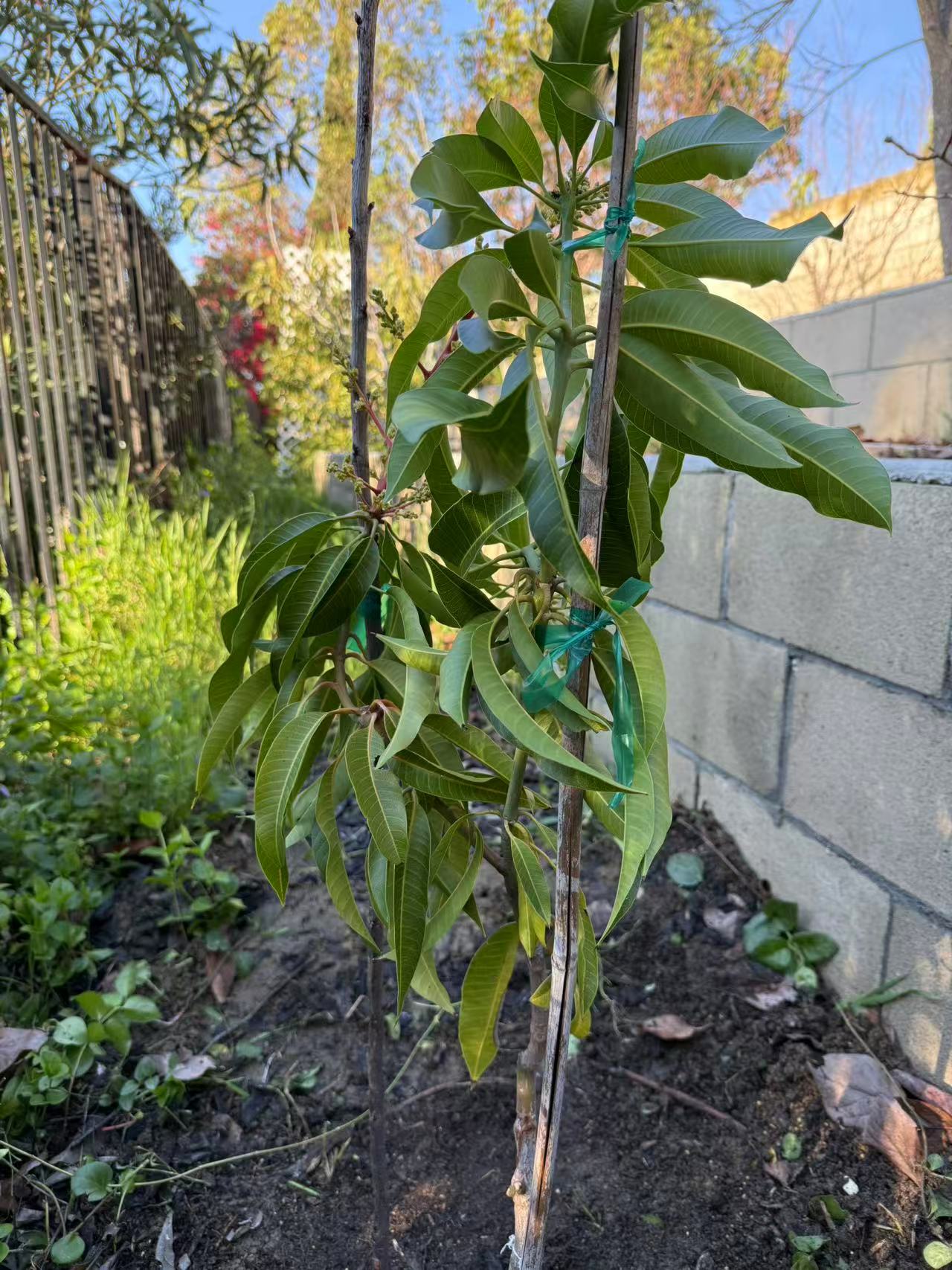
    • Current Bloom Status: The photo shows healthy panicles (flower spikes) emerging at the top. This proves the tree responded perfectly to your “prune and build” strategy last year and is now biologically primed to support fruit.

    📅 Precise Ripening Months

    The Glenn is an early-to-mid season variety, delivering premium tropical flavor right in the heat of summer:

    • Flowering: February to April
    • Expected Harvest: August to September.
    • Ripeness Cues: This is a stunningly beautiful fruit. When ripe, the skin transitions from green to a bright, eye-catching golden yellow, often developing a gorgeous peach-orange/red blush on the sun-exposed side. It is ready to pick when it emits a strong, room-filling fruity aroma and yields slightly to a gentle squeeze.

    📝 My Gardening Notes

    • The Identity Twist: Purchased in early 2024 from Mimosa OC. Initially thought to be the late-season giant ‘Kent’, a closer look at the tag revealed it is actually a ‘Glenn’—a top-tier, peach-flavored gem.
    • The Wisdom of Restraint: Stripping the heavy blooms in 2025 was a tough but necessary decision, preventing the slender main trunk from snapping under the weight of premature fruit. Now, in Spring 2026, the tree is pushing out healthy panicles again. It is finally time to enjoy the sweet rewards of that patience.

    🛠️ Care & Maintenance (The 2026 Fruiting Plan)

    • Extreme Thinning & Staking (Critical): As the photo clearly shows, the main trunk is still quite thin and heavily reliant on the bamboo stakes. While you can let it fruit this year, you must aggressively thin the tree down to a maximum of 1 or 2 mangoes total. Crucially, the specific branch holding the fruit must be securely tied to the bamboo support; otherwise, the weight of the growing fruit will snap the branch.
    • Fungal Protection: Despite its resistance to Anthracnose, Southern California’s spring weather (warm days with cool, dewy nights) is the perfect breeding ground for Powdery Mildew. Apply Neem Oil before the panicles fully open to protect the delicate blossoms.
    • Post-Set Feeding: Once the flowers drop and the remaining fruitlets reach the size of a pea without falling off, apply a potassium-rich fruit tree fertilizer to support rapid fruit expansion and sugar development.
  • Red & White Dragon Fruit

    Red & White Dragon Fruit

    🌵 Plant Profile: Red & White Dragon Fruit

    📊 Basic Info

    • Variety: Red-fleshed & White-fleshed Dragon Fruit
    • Planting Date: Summer 2023
    • Source: Home Depot seedlings / Custom DIY 2×4 Wooden Trellis
    • Yield Performance: ★★☆☆☆ (Bloomed in 2025; primed for its first true harvest in 2026)
    • Flavor Profile: The red variety offers intense sweetness with subtle berry notes, while the white variety provides a refreshing, crisp, kiwi-like crunch.

    📖 Variety Overview & Diagnosis

    Planting both red and white varieties on the same structure is a brilliant horticultural strategy. Many dragon fruits are self-sterile and require cross-pollination. Having two different genetics drastically increases fruit set and size.

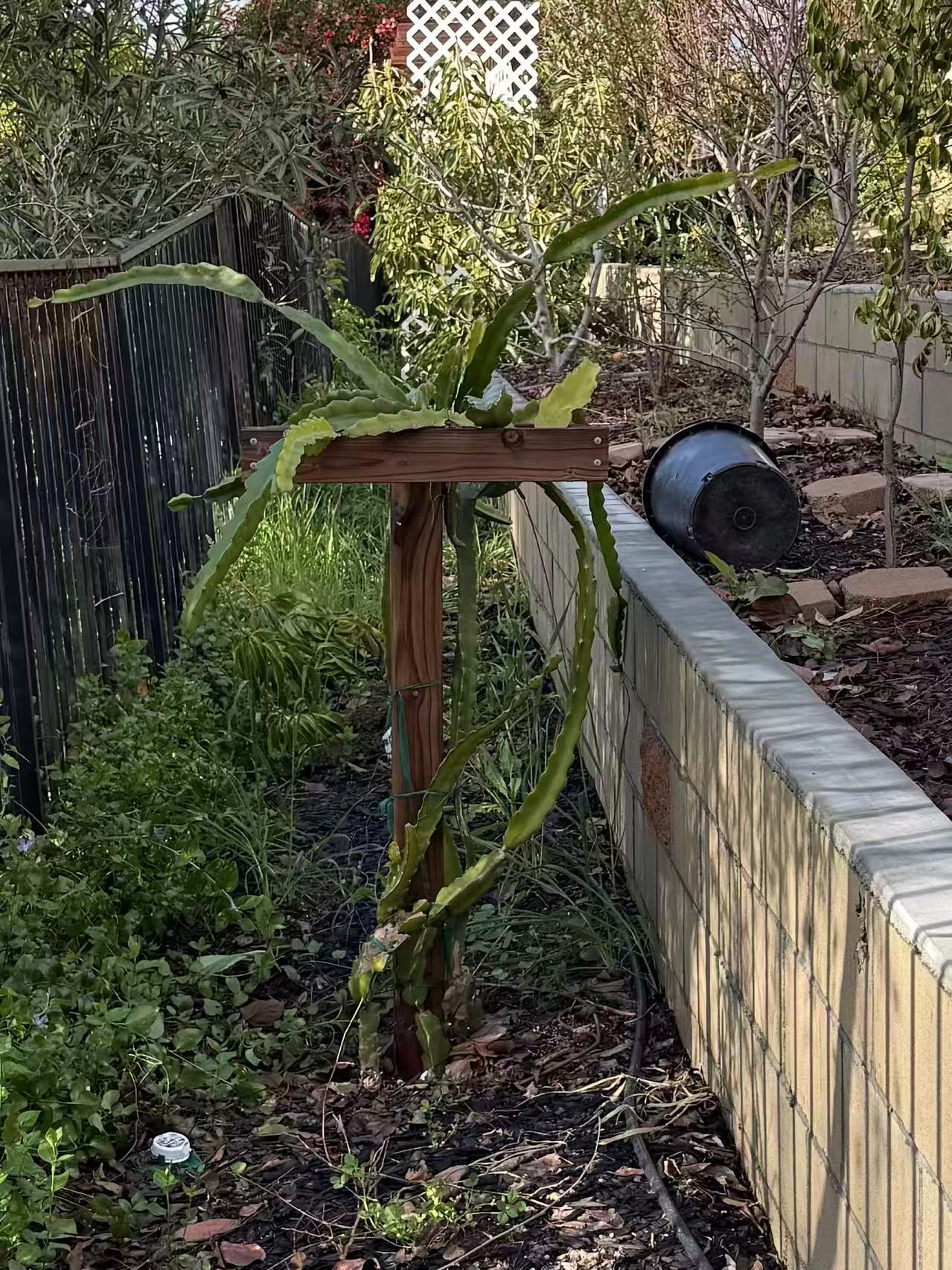
    • The Custom Trellis: Dragon fruit vines become incredibly heavy as they mature. The 2×4 wooden crown trellis you built from scratch is exactly the robust, professional-grade support this epiphytic cactus needs to thrive.
    • The 2025 Bloom Mystery: Blooming without setting fruit in its second year is completely normal. Dragon fruits are nocturnal bloomers. If night-time pollinators (like certain moths) miss the brief midnight window, the flower simply drops off.

    📅 Precise Ripening Months

    Fueled by the intense Southern California summer sun, the cycle from flower to ripe fruit is a rapid 30 to 50 days:

    • Flowering: June to September (Blooms typically open at night, often in waves coinciding with hot weather).
    • Expected Harvest: August to November.
    • Ripeness Cues: The fruit is ready to harvest when the skin turns a vivid, even pink/red and the tips of the “scales” (bracts) just begin to yellow and dry out.

    📝 My Gardening Notes

    • The DIY Project: Established in Summer 2023. Building the heavy-duty wooden trellis was a crucial investment, combining practical carpentry with orchard planning to support the plant’s massive future weight.
    • The 2026 Outlook: The vines have beautifully cascaded over the wooden frame. This umbrella shape naturally induces flowering. With the trial run of 2025 behind it, 2026 is the year of the harvest.

    🛠️ Care & Maintenance

    • Hand Pollination (The Secret Weapon): When those massive, beautiful flowers open this summer, I will take a small paintbrush between 9 PM and midnight and transfer pollen from the white flowers to the red flowers (and vice versa) to guarantee fruit set.
    • Tip Pruning: I will trim the very tips of the hanging branches if they get too close to the ground. This stops vegetative growth and forces the plant to push out flower buds instead.
    • Summer Feeding: Starting in May, I will apply a potassium-rich fertilizer to support the upcoming waves of massive blooms.
  • Pomegranate

    Pomegranate

    🍎 Plant Profile: Pomegranate (Likely Tunisian Soft-Seed)

    📊 Basic Info

    • Guessed Variety: Tunisian Soft-Seed Pomegranate (突尼斯软籽石榴)
    • Planting Date: Summer 2022
    • Source: A gift from a Chinese nursery
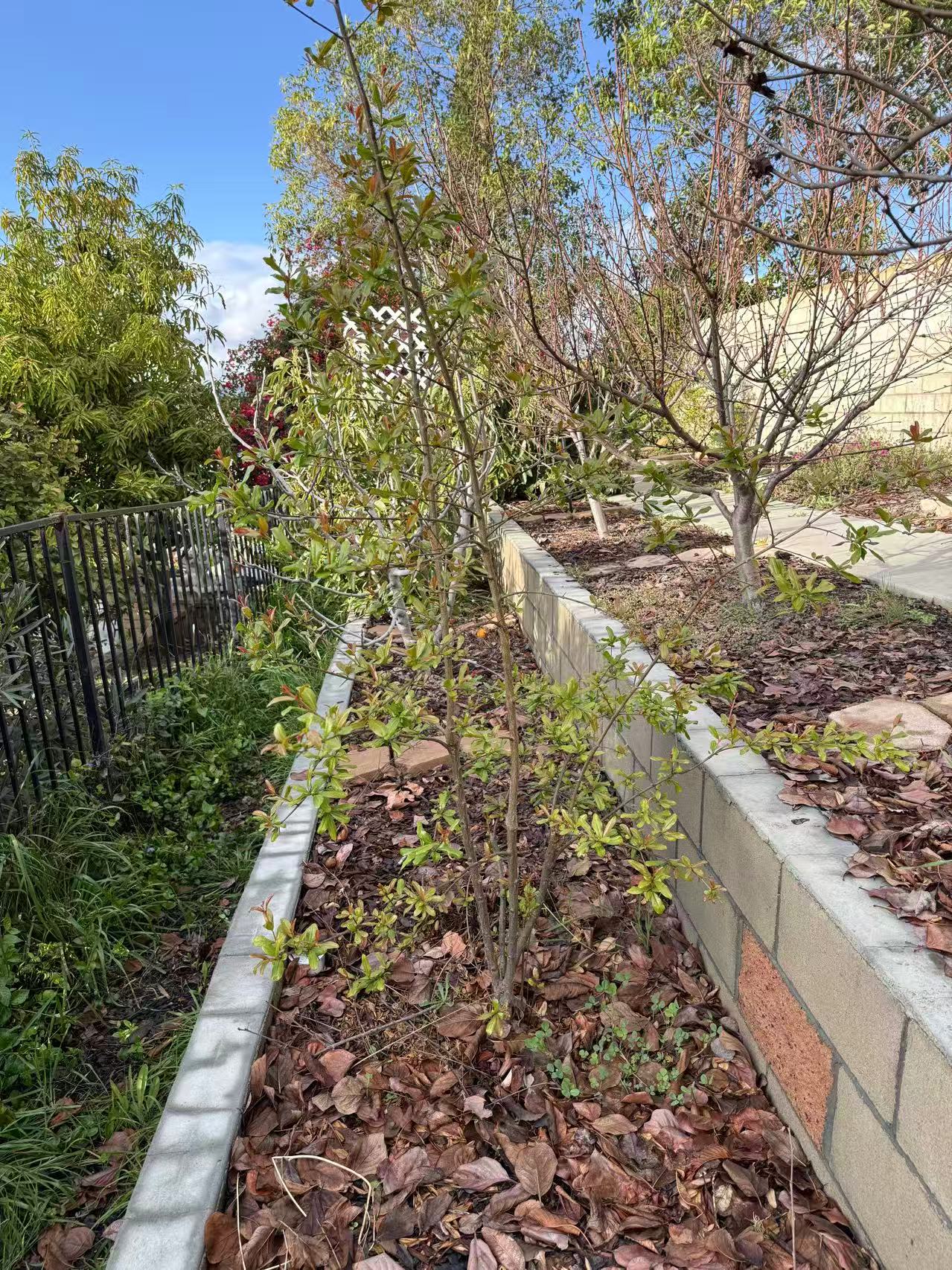
    • Yield Performance: ★☆☆☆☆ (Currently all foliage, zero fruit; reaching maturity now)
    • Flavor Profile: If it’s the “premium/tasty” variety championed by Chinese nurseries, it is likely a soft-seeded type. Expect incredibly sweet, ruby-red arils with seeds so soft they can be chewed and swallowed effortlessly.

    📖 Variety Speculation & Diagnosis

    The “Tunisian Soft-Seed” has absolutely dominated the premium pomegranate market in China. If a nursery is sending a high-quality freebie, this is the prime suspect.

    • Why the Delay in Fruiting? 1. Age: Pomegranates are not instant producers. They typically require 3 to 5 years to establish before setting fruit. Planted in mid-2022, 2026 marks its 4th year—the exact window when it should start flowering. 2. Overcrowded Canopy: The photo shows a very dense, multi-stemmed shrub. When a pomegranate is too congested, it spends all its energy pushing vegetative growth to compete for sunlight, rather than producing fruiting buds.

    📅 Precise Ripening Months

    In the long, hot summers of Southern California, these pomegranates ripen beautifully in early autumn:

    • Flowering: May to June (Expect stunning, vibrant orange-red blossoms).
    • Expected Harvest: Late September to October.
    • Ripeness Cues: It is ready when the skin turns a deep red and the fruit takes on a slightly “squared-off” or blocky shape, indicating the arils inside are swollen with juice.

    📝 My Gardening Notes

    • The “Mystery Box”: Arrived as an unexpected bonus and has shown incredible vigor.
    • The Turnaround Year: It has been allowed to grow wild into a thick bush. To unlock its fruiting potential in 2026, I need to shift its energy from making leaves to making flowers.

    🛠️ Care & Maintenance (The 2026 Bloom Strategy)

    • Aggressive Thinning (Crucial): I will remove the basal suckers and completely clear out the crossing, twiggy growth in the center of the bush. Selecting 3 to 5 strong main trunks and opening the center to sunlight is mandatory for flower production.
    • Phosphorus Push: As the spring foliage emerges, I will switch to a high-phosphorus/high-potassium “bloom booster” fertilizer and strictly avoid heavy nitrogen.
    • Strategic Stress: Allowing the soil to dry out slightly just before the expected late-spring bloom can “stress” the tree into prioritizing flower production over more leaf growth.
  • Malaysian Red Guava

    Malaysian Red Guava

    🌺 Plant Profile: Malaysian Red Guava

    📊 Basic Info

    • Variety: Malaysian Red Guava
    • Planting Date: Early 2025
    • Source: Mimosa Nursery
    • Yield Performance: ★★☆☆☆ (Demonstrated fruiting capability in 2025; pruned for growth, now primed for a breakout year in 2026)
    • Flavor Profile: Features stunning deep pink/red flesh. It is renowned for its intense, floral, and tropical aroma that surpasses many standard white/green varieties.

    📖 Variety Overview

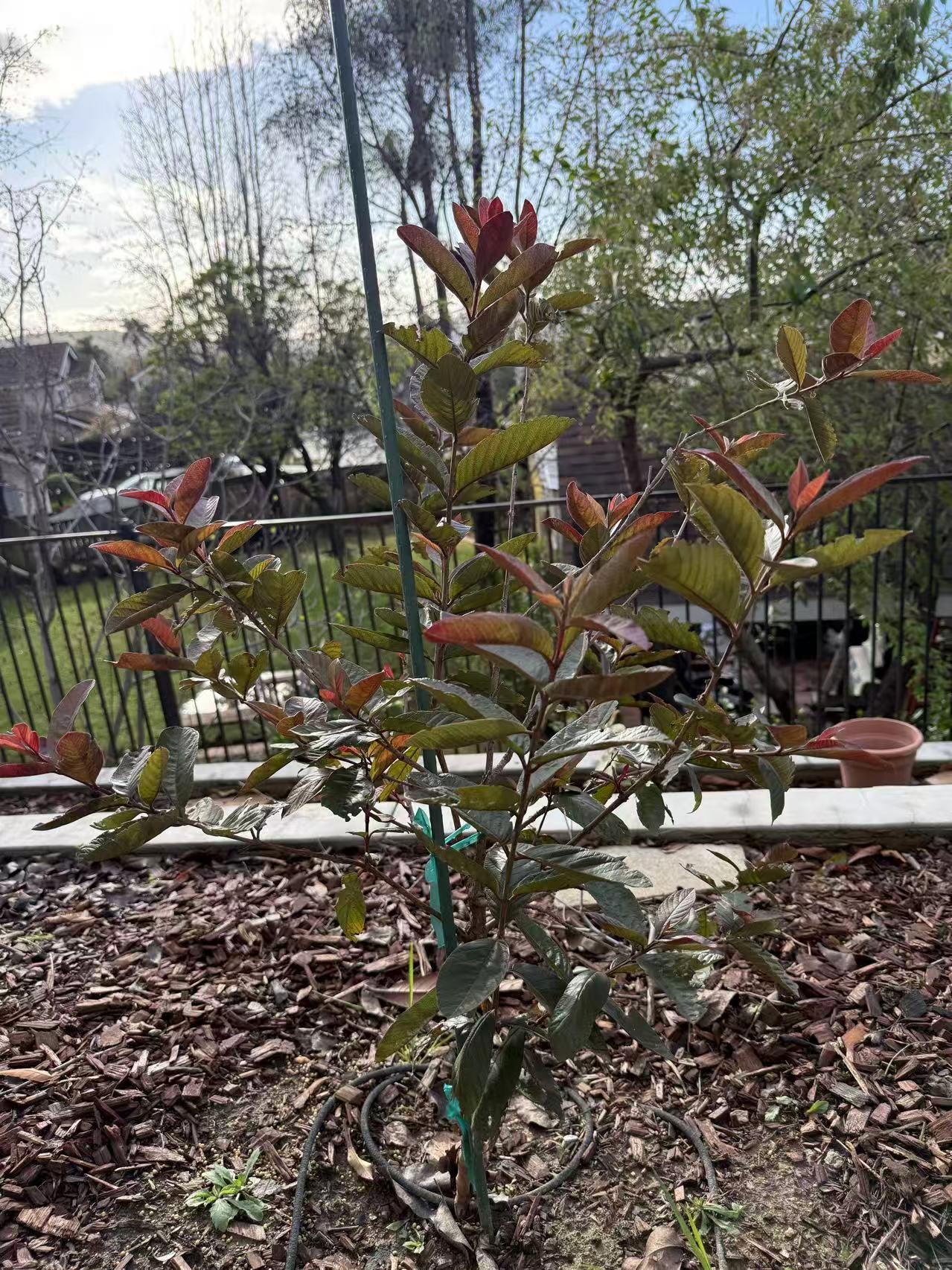
    The striking burgundy and bronze new foliage visible in your photo immediately identifies this as the “Red Malaysian” variety. It doubles as a spectacular ornamental plant and a prolific fruit producer.

    • Appearance: Unlike typical guavas, this variety boasts reddish leaves, produces gorgeous pink flowers (instead of white), and yields fruit with a distinct red/maroon blush on the skin.
    • Growth Habit: It thrives in the Rowland Heights heat. Your decision to strip all the developing fruit in 2025 was a masterclass in orchard management. By doing so, you prevented the young tree from exhausting itself, allowing it to channel all its energy into establishing the robust root system and strong framework we see today.

    📅 Precise Ripening Months

    Guavas enjoy a very long fruiting season in Southern California and can sometimes bloom multiple times a year:

    • Primary Harvest Season: September to December.
    • Secondary Window: Occasionally, a mild winter/warm spring will induce an early crop around May to June.
    • Ripeness Cues: The fruit is ready when the skin transitions to a brighter, slightly yellowish-red, yields to gentle thumb pressure, and emits an unmistakable, room-filling guava fragrance.

    📝 My Gardening Notes

    • The Beautiful Addition: Acquired from Mimosa Nursery in early 2025. Its crimson leaves provide a beautiful pop of color against the standard green backdrop of the orchard.
    • The Year of Rooting: Sacrificing the 2025 fruit crop was tough but necessary. The vibrant flush of red leaves at the top of the canopy proves the tree is incredibly healthy and fully prepared to support a heavy crop in 2026.

    🛠️ Care & Maintenance

    • Bloom Boosting: As the spring flush accelerates (evident by the active red tips), it is time to apply a phosphorus and potassium-rich fertilizer to encourage heavy blooming.
    • Hydration: Guavas are thirsty trees. Consistent deep watering is mandatory during the bloom and fruit-set stages; drought stress will cause it to drop its flowers.
    • Pest Defense: The incredible aroma of ripe guavas is a magnet for fruit flies. I will need to bag the fruit when they reach the size of a ping-pong ball to protect the harvest.
  • Pink Guava

    Pink Guava

    🍐 Plant Profile: Pink Guava

    📋 Basic Info

    • Variety Name: Pink Guava (A premium tropical guava variety commonly stocked by Mimosa Nursery)
    • Planted Date: January 2026 (Purchased from Mimosa Nursery)
    • Yield Performance: ★☆☆☆☆ (A “newborn” just planted a month ago; currently at zero yield, focusing entirely on survival and rooting)
    • Taste Profile: (Expected) A classic tropical flavor bomb! When ripe, the flesh is an inviting soft pink, with a creamy, sweet, and incredibly aromatic profile. It’s top-tier for eating fresh or juicing.

    📖 Variety Overview Unlike the Strawberry Guava mentioned earlier, this is a true, large tropical “Guava.”

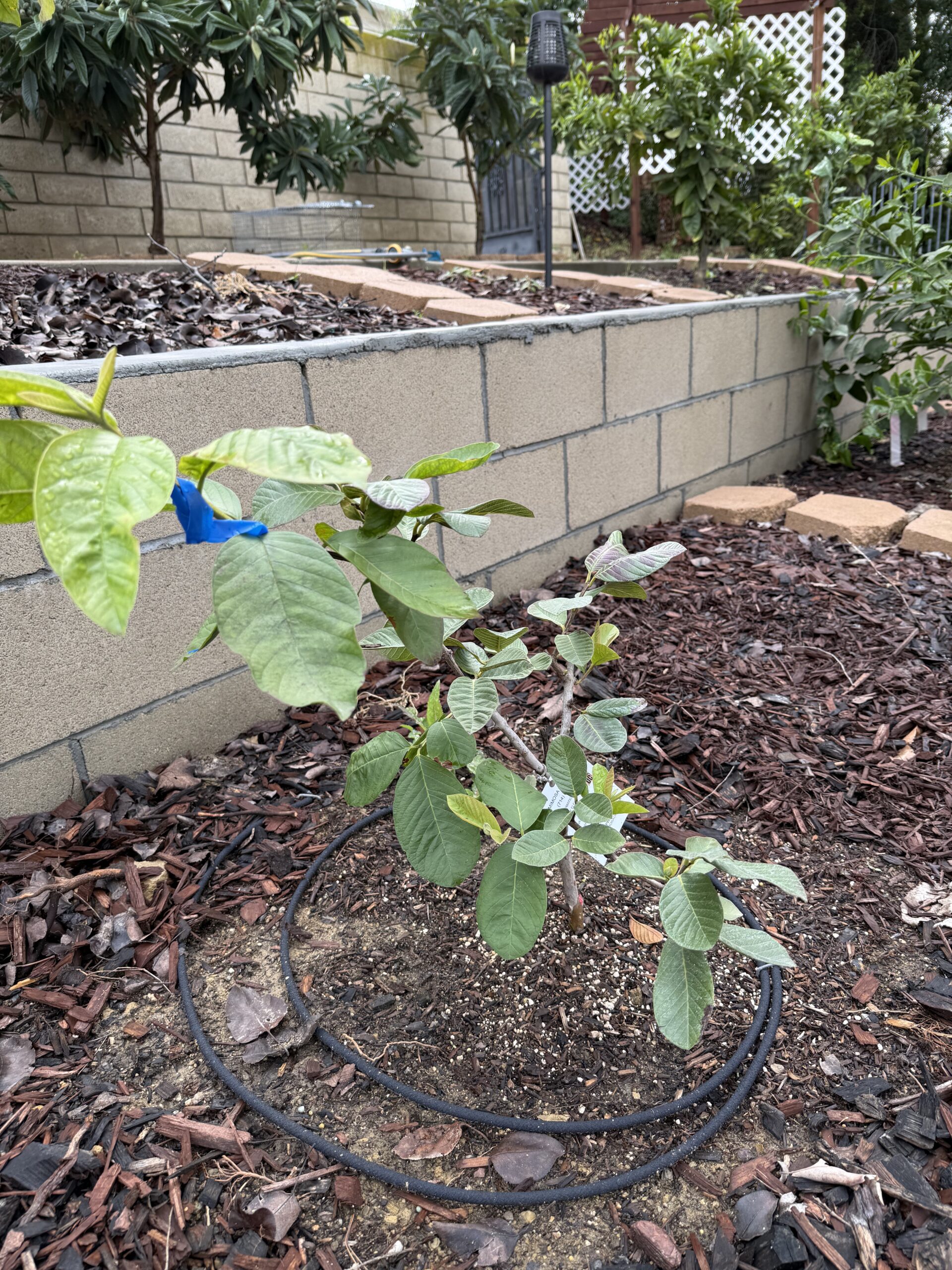
    • Appearance: As clearly seen in the photo, it has large, slightly corrugated leaves with very prominent veins. When mature, its trunk will also peel to reveal smooth, bronze-colored bark.
    • Growth Habits: It is an absolute heat-lover, thriving in the blazing Southern California summer sun. The trade-off is that it is extremely cold-sensitive as a young sapling. Once it fully establishes its roots in the Rowland Heights soil and survives the first couple of risky years, its growth rate will be astonishing.

    📅 My Planting Log

    • The Baby of the Orchard: It officially joined the orchard in the dead of winter, January 2026. You can still see the blue nursery tape holding a branch and the white plant tag at the bottom, proving just how “new” it is.
    • A Brave Winter Survivor: Looking closely at the photo, some leaves have a slight purplish or dark bronze tint. This is a completely normal stress response for tropical guavas experiencing cold winter temperatures (increased anthocyanin production to protect the leaves). For a sapling planted just last month, it looks very perky, upright, and without severe wilting, indicating it is holding its ground well.

    🛠️ My Care Guide (For Newly Planted Saplings)

    • Strict Winter Protection: This is a matter of life and death right now. Because it was just planted in January, its root system hasn’t expanded at all. If it encounters frost below 32°F (0°C), it will take a massive hit. I will closely monitor the weather forecast until spring truly arrives.
    • The Perfect Drip Ring: The circular drip irrigation line I set up around it in the photo is textbook perfect! This ensures water soaks evenly around the root zone. Since it’s a fresh transplant, I will keep the soil within this drip ring consistently slightly moist, but never waterlogged.
    • Remove Ties: Once it settles in a bit more, I will remember to untie or cut that blue plastic tape. This prevents the tape from girdling or cutting into the bark as the tree grows rapidly in the spring. The only job right now is to wait patiently for spring—strictly no fertilizer at this stage.
  • Chinese Hawthorn

    Chinese Hawthorn

    🍎 Plant Profile: Chinese Hawthorn (Shanzha)

    📊 Basic Information

    • Variety Name: Chinese Hawthorn (Crataegus pinnatifida)
    • Planting Time: Summer 2022
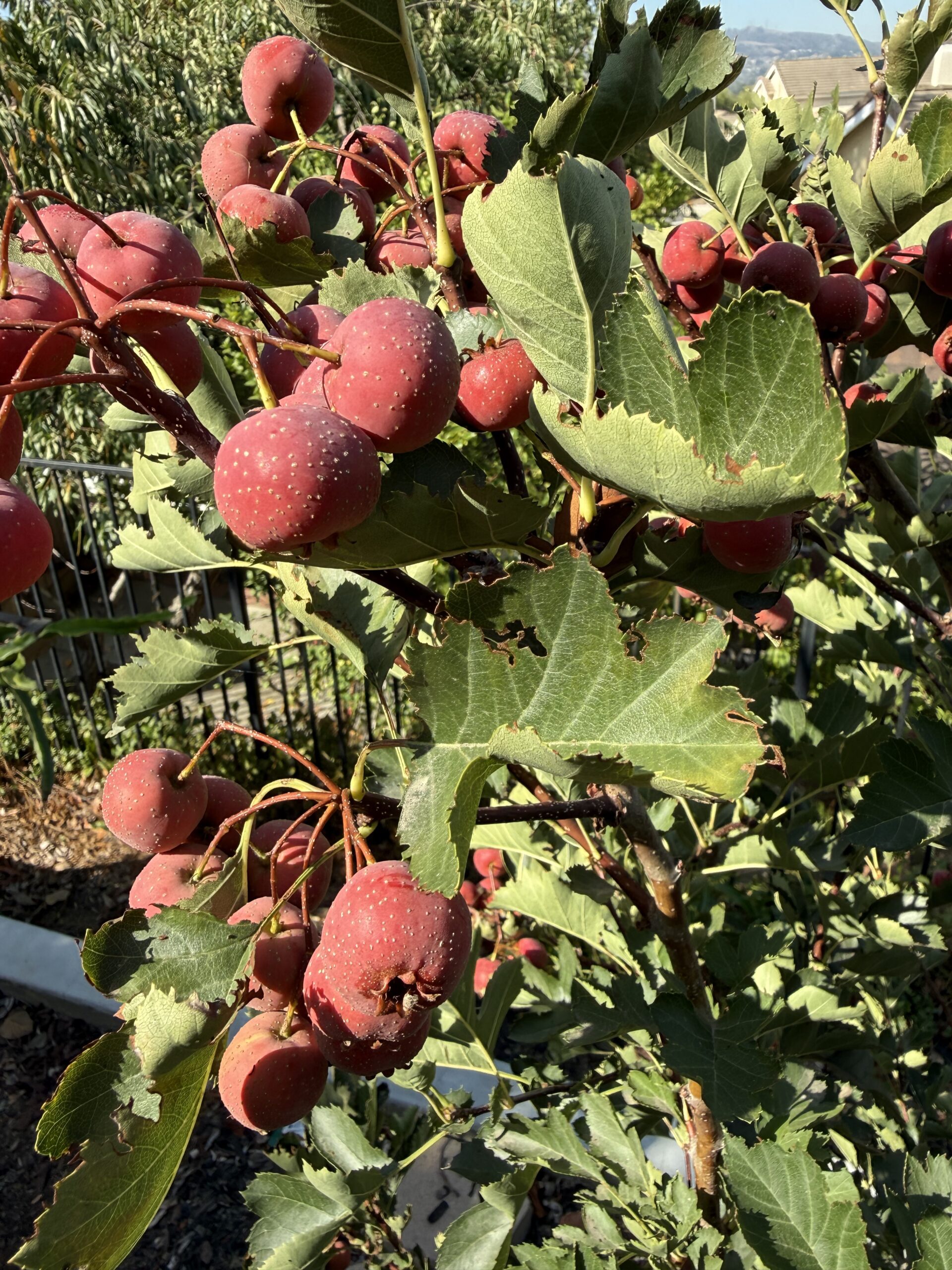
    • Yield Performance: ★★★★☆ (Three years after planting, the branches are heavily laden with bright red fruit)
    • Taste Characteristics: The flesh becomes soft and mealy when fully ripe, with the classic signature tartness of Hawthorn; it is the perfect ingredient for traditional Chinese desserts.

    📖 Variety Introduction This Hawthorn tree is the most meaningful tree in my orchard. Growing such an authentic North Chinese flavor in the typical Southern California climate of Rowland Heights is truly special.

    • Appearance: The fruits are evenly sized with a deep, passionate red skin speckled with small lenticels, looking incredibly inviting.
    • Flavor Profile: The taste is very authentic. When eaten fresh, the soft texture and tart zing immediately bring back childhood memories. While it remains slightly tart on its own, that acidity is its charm—especially the mealy texture, which signals that the fruit is perfectly ripe.
    • Growth Habit: It thrives under the California sun with its characteristic serrated dark green leaves. While Hawthorns are generally cold-hardy, this tree has clearly adapted well to our local warmth and has delivered a bumper harvest in 2026.

    📝 My Planting Record

    • A Promise for Tanghulu: I planted this in the summer of 2022 for a very simple reason—Joy wanted to eat Tanghulu (candied hawthorn sticks). Since fresh Hawthorns are hard to find in California, I decided to grow my own. After a few years of waiting, it has finally rewarded my effort with a tree full of red fruit.
    • The Perfect Dessert Partner: When these soft, tart fruits are coated in crunchy, crystal-clear syrup to make Tanghulu, the balance of sweet and sour is perfection. This isn’t just fruit; it’s the signature sweet taste of our home.

    🛠️ My Care Essentials

    • Pruning and Shaping: To make harvesting easier for Joy, I regularly prune dense branches to maintain airflow and light penetration. This ensures every Hawthorn gets enough sun to develop that deep red color and higher sugar content.
    • Balanced Fertilization: During the flowering and fruiting stages, I supplement with organic fertilizers high in phosphorus and potassium to support such a heavy yield and maintain the quality of the flesh.
    • Watering Control: Especially during the fruit expansion stage, the Rowland Heights climate can be quite dry. I maintain steady irrigation to prevent the fruit from shriveling.
    • Thinning and Protection: Since the fruit clusters are so dense this year, I may selectively thin them out to ensure the remaining Hawthorns grow larger and maintain the best quality.
  • Black Mission Fig

    Black Mission Fig

    Here is the formal English version for your Black Mission Fig profile:


    🪴 Plant Profile: Black Mission Fig

    📍 Basic Information

    • Variety Name: Black Mission (Ficus carica ‘Mission’)
    • Planting Date: Early 2023
    • Yield Performance: ★★★★★ (Entered peak production in 2025 with exceptional yields)
    • Flavor Profile: Intensely sweet, jam-like texture, rich flavor with a natural syrupy finish

    📖 Variety Introduction

    The Black Mission fig is a classic and highly esteemed California variety, renowned for its deep coloration and superior sweetness.

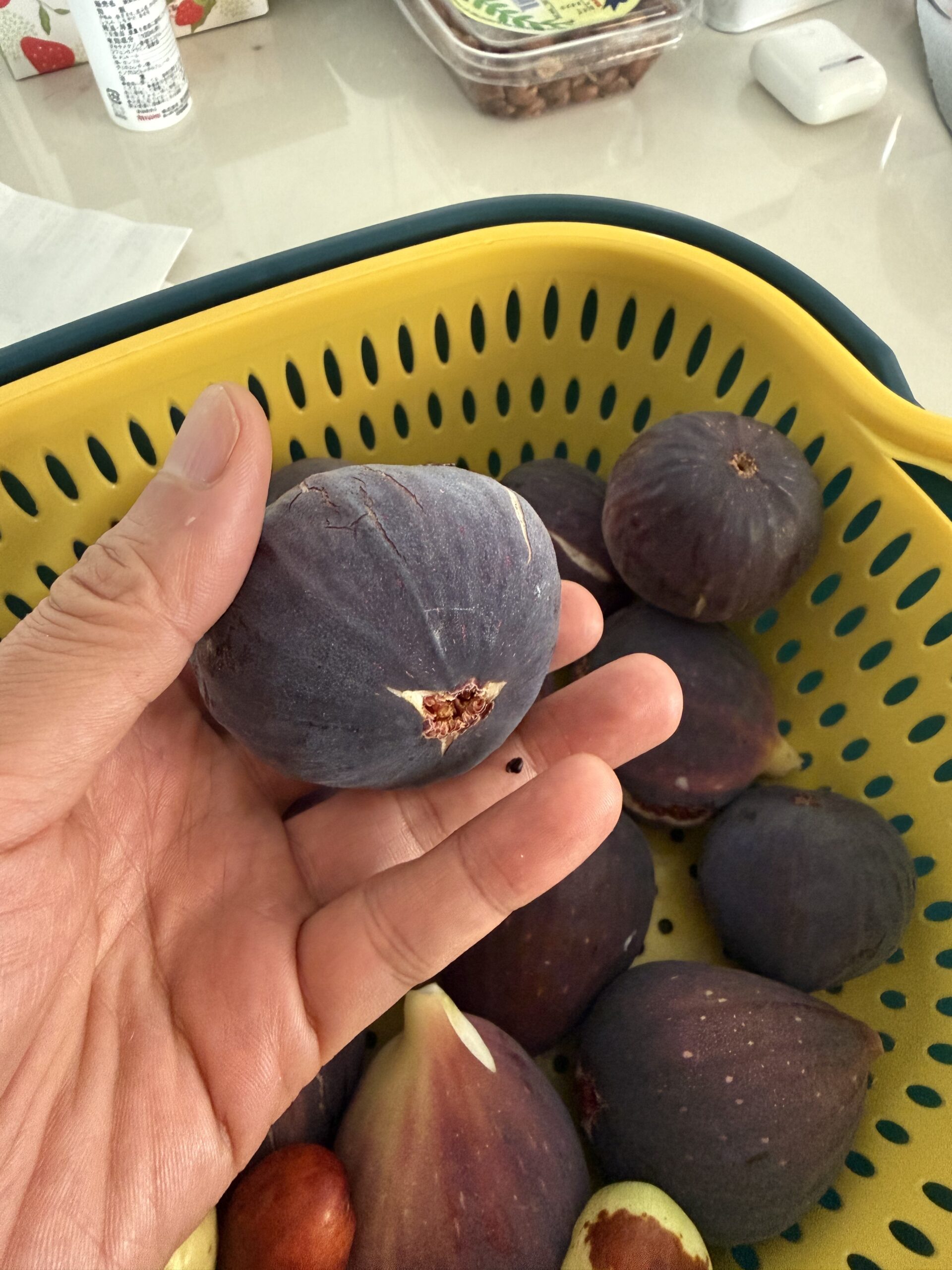
    • Appearance: The fruit is a plump, pear-shaped fig that transitions to a deep purple or nearly black skin upon maturity. The interior reveals an inviting strawberry-red flesh with a fine, delicate texture.
    • Flavor Profile: As a representative of high-sugar varieties, it offers a soft, honey-like consistency. Once fully ripe, the skin becomes thin, and the flesh provides a gourmet eating experience, making it a top choice for fresh consumption.
    • High Productivity: This variety is highly adaptable and has the potential to produce two crops per year (Breba and Main crops), making it ideal for home orchards.

    📓 My Planting Records

    This tree joined the orchard in early 2023 and has become the garden’s “productivity champion” in just two years.

    • Growth Vigor: Since planting, it has shown incredible vitality. Under the abundant sunlight of Rowland Heights, the canopy has expanded rapidly with well-balanced branching.
    • Harvest Milestone: Following two years of establishment, the tree saw an explosive harvest in 2025. The branches were heavily laden with deep purple fruits, providing more than enough for fresh eating and sharing with neighbors.
    • Climate Adaptation: It thrives in the dry California climate. During the 2025 harvest season, the sugar accumulation was excellent, as evidenced by the fine “sugar cracks” appearing on the skin—a hallmark of high quality.

    🛠️ Maintenance Essentials

    • Structural Pruning: Due to its vigorous growth, I perform structural pruning during the winter dormancy period. This maintains a manageable height for harvesting and stimulates new shoot growth for the following year’s crop.
    • Wildlife & Harvesting: Because of its high sugar content, ripe Black Mission figs are a favorite for birds and squirrels. It is best to harvest as soon as the fruit turns color or use bird netting to protect the crop.
    • Water Balance: While figs are drought-tolerant, providing consistent moisture during the fruiting stage prevents the fruit from undersizing. However, I avoid overwatering during the final ripening phase to prevent excessive splitting or diluted sweetness.
    • Soil Health: I supplement with organic fertilizer every early spring to ensure the tree has the nutrient reserves needed for a heavy production year.