

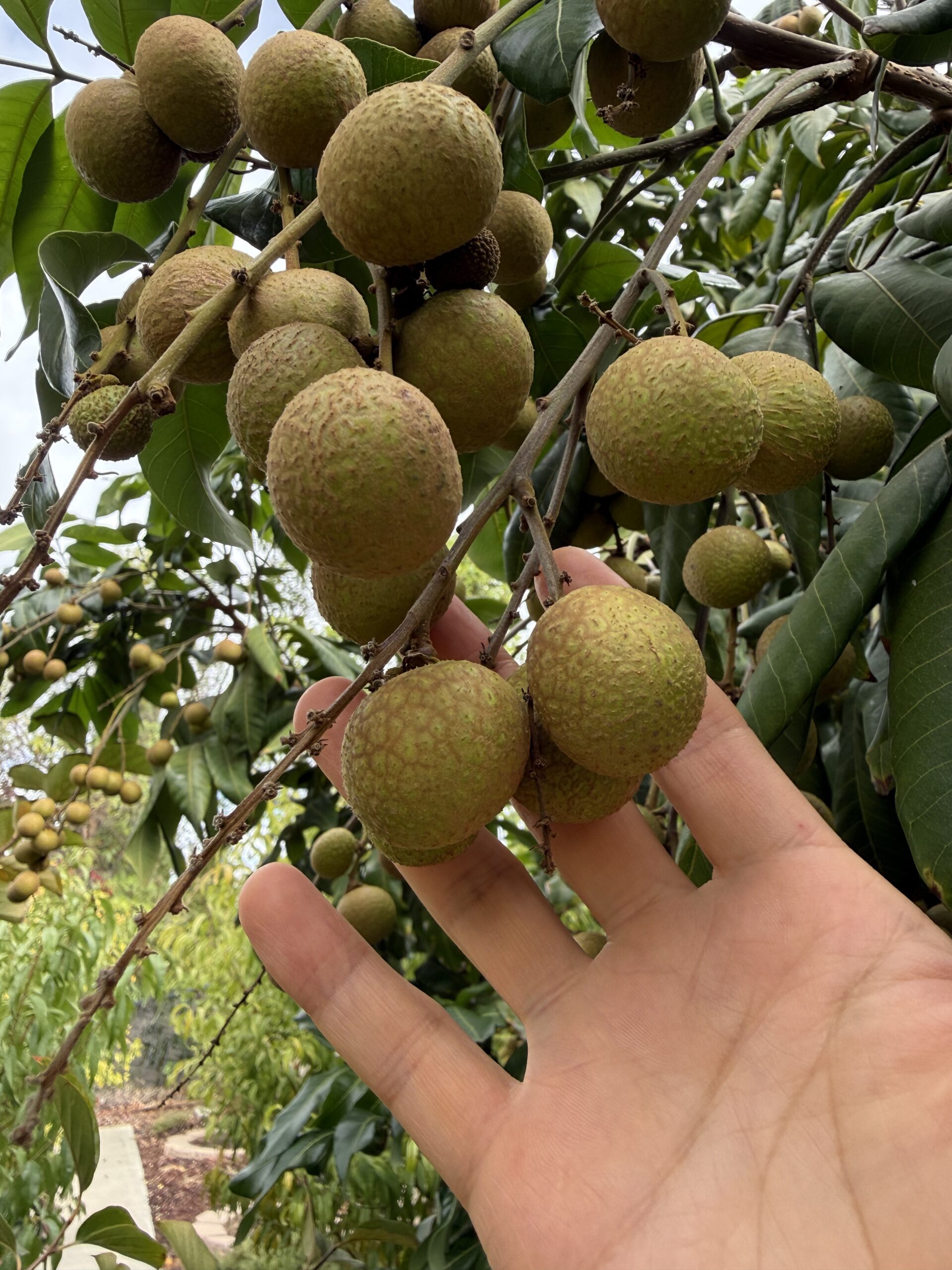
🍈 Plant Profile: Longan
📊 Basic Information
- Variety Name: Highly likely Kohala Longan
- Planting Time: Original old tree in the orchard, many years old
- Yield Performance: ★★★☆☆ (Yield is highly unstable with a pronounced “alternate bearing” pattern, but explosive during a “big year”)
- Taste Characteristics: Crystal clear and translucent flesh, abundantly juicy, extremely sweet like honey, with a rich, classic longan aroma.
📖 Variety Introduction This longan tree is a “senior veteran” in my orchard. If it truly is the Kohala variety, it is definitely one of the most popular and excellent varieties in California, famous for its large fruit, small seeds, thick flesh, and extreme sweetness.
- Appearance: Its shell is yellowish-brown with a slightly rough, netted texture. Every harvest season, looking at this heavy, plump cluster of fruit I’m holding in my hand fills me with the joy of a great harvest.
- Flavor Profile: Peeling back the thin shell reveals pearl-like, translucent flesh. One bite and the juice overflows; the sweetness rushes to the taste buds. It completely rivals the top-tier longans sold in markets and is incredibly addictive to eat.
- Growth Habit: As a typical subtropical evergreen fruit tree, it thoroughly enjoys the warm sunshine of Rowland Heights. However, these types of fruit trees share a frustrating common trait—if left without human intervention, they easily fall into a cycle of “alternate bearing” (biennial bearing).
📝 My Planting Record
- Planted by Predecessors: This tree is a precious asset left behind by the previous homeowner. After years of weathering, it has taken deep root in my orchard and has become my family’s most anticipated source of sweetness every autumn.
- A Crazy “Big Year”: Its temper is somewhat unpredictable, and its yield fluctuates wildly. But in 2025, it ushered in a super “big year”! The entire tree was laden with heavy fruit clusters, the yield was astonishing, and every single one was sweet to the core. It felt like it was making up for all the missing yields from previous years at once.
- A Sweet Trouble: Although a bumper harvest in a big year makes me incredibly happy, I know this means the tree has consumed a massive amount of nutrients. If I don’t quickly give it some heavy post-harvest care to replenish its nutrition, next year will definitely be a barren “small year.”
🛠️ My Care Essentials
- Breaking the Alternate Bearing Curse (Fruit Thinning): To make its future yield more stable, I have to learn to be ruthless. In the spring of future “big years,” when the flower panicles have just formed or young fruits have just set, I need to prune away about 1/3 to 1/2 of them. This not only allows the remaining fruits to grow larger but also preserves the tree’s nutrients so it can bloom and fruit normally the following year.
- Post-harvest Fertilization: It produced so much fruit in 2025 that it practically exhausted all its energy. Immediately after the harvest, I must give it a comprehensive organic fertilizer rich in nitrogen, phosphorus, and potassium, and apply a thick layer of mulch. This helps it quickly recover its vitality and store energy for the coming year.
- Water Management: Longans desperately need water during the flowering and fruit expansion stages. During the long, dry California summers, I will give it deep watering to ensure the fruits can absorb enough moisture to become plump and juicy, while also ensuring good drainage to prevent root rot.
- Winter Pruning: After harvest and in late winter to early spring, I will give it a proper pruning. I’ll primarily cut off the leftover fruit stalks, dead branches inside the canopy, and overly dense crossing branches to maintain good airflow and light penetration, which greatly reduces the occurrence of pests and diseases.