

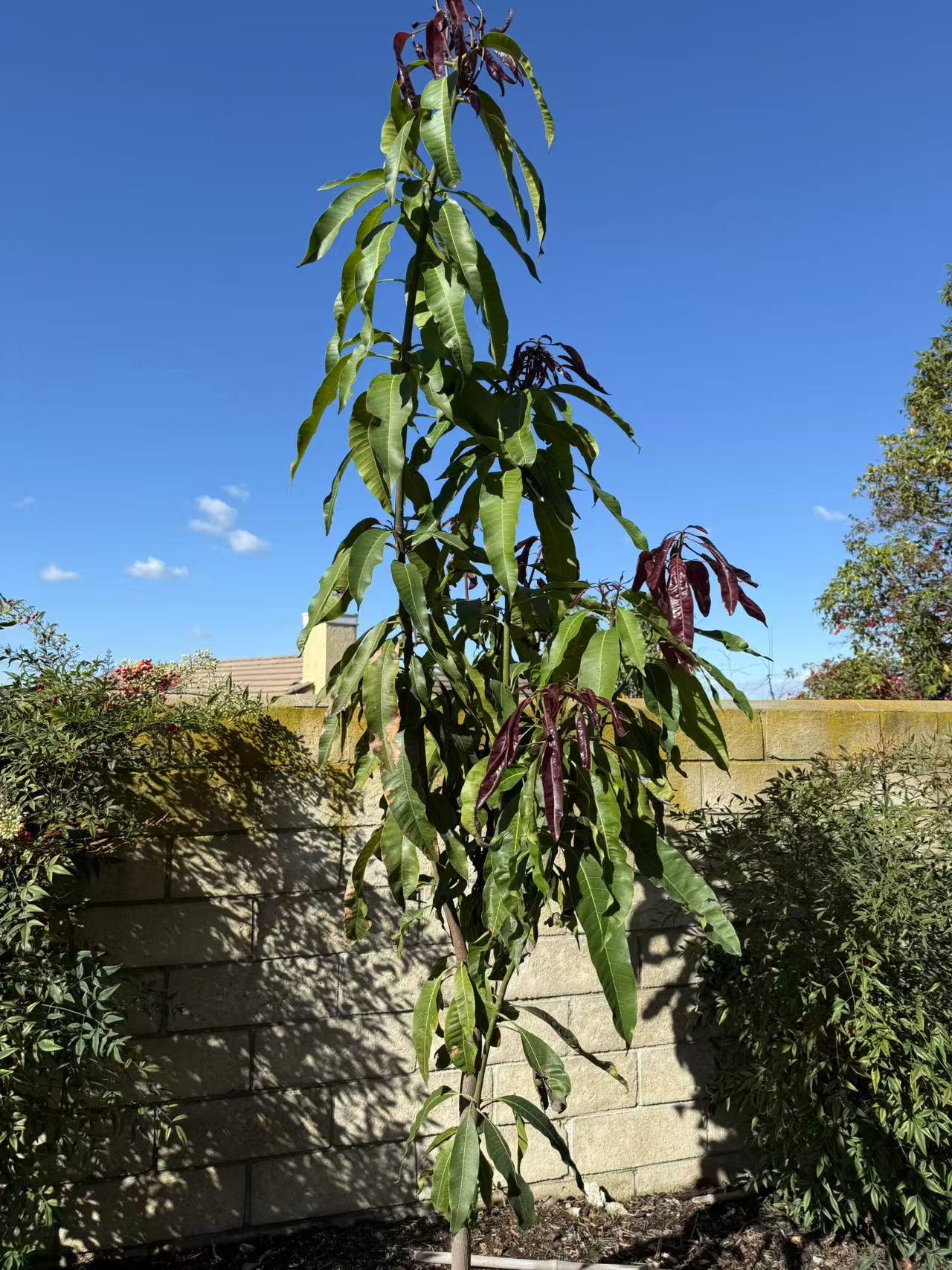
🥭 Plant Profile: Manila Mango
📊 Basic Info
- Variety: Manila Mango
- Planting Date: 2023
- Yield Performance: ★★☆☆☆ (First harvest of 2 fruits in 2025; entering its productive years)
- Flavor Profile: Famous for its paper-thin seed, incredibly sweet and creamy flesh, and absolute lack of stringy fibers.
📖 Variety Overview
The Manila is arguably the most reliable and highly recommended mango variety for Southern California backyard orchards due to its robust nature.
- Appearance: Characterized by long, narrow leaves. The new growth flushes (visible at the top of the photo) emerge as a striking reddish-bronze before hardening off into a deep green.
- Growth Habit: It exhibits excellent cold tolerance compared to other tropical mangoes. Its placement near the block wall is highly strategic, as the wall radiates retained daytime heat during cooler nights.
📅 Precise Ripening Months
Mangoes in our region enjoy a long, hot summer to develop their sugars:
- Expected Harvest: August to September.
- Ripeness Cues: The fruit is ready when the skin transitions to a vibrant, golden yellow, develops a slight waxy sheen, yields to gentle pressure, and emits a strong tropical aroma.
🩺 Health Check: Powdery Mildew
The white powder and curling on the leaves you observed is a textbook case of Powdery Mildew.
- The Cause: The local spring weather pattern—warm days paired with cool, damp nights—creates the perfect breeding ground for this fungus. It aggressively targets the tender new red flushes and developing flower panicles.
- The Impact: Left untreated, it will blanket the flowers, causing them to drop before fruit can set, directly impacting this year’s harvest.
🛠️ Care & Maintenance
- Fungal Treatment (Urgent): Apply a fungicide such as Neem Oil, liquid sulfur, or a bio-fungicide like Bacillus subtilis every 7–10 days during the spring flush and bloom. Pro-tip: Only spray in the early morning or late evening to prevent leaf scorch.
- Canopy Airflow: Prune away heavily infected leaves and any crossing interior branches. Good air circulation is the natural enemy of powdery mildew.
- Nutrient Shift: Back off on high-nitrogen fertilizers right now (which just push out more vulnerable soft leaves) and focus on phosphorus and potassium to strengthen the tree and support fruit set.